Forged for Precise Management of Flow
When you’re managing a high-pressure system, the last thing you need is a complex bill of materials or a joint that requires hours of specialized welding and NDT. Whether you are a buyer trying to lean out your inventory or an engineer facing a tight turnaround, you need connections that don’t add stress to your day—or your pipes.
For industries managing thousands of specifications, like oil and gas, petrochemical, and power generation, every item in inventory represents both capital and complexity. Penn Machine’s engineered forged branch connections help consolidate SKUs, cut lead times on RFQs, and ensure reinforced reliability across demanding applications.
Key Takeaways
- Forged branch connections deliver integrated reinforcement and dimensional uniformity.
- Inventory consolidation reduces complexity in RFQs and warehouse management.
- Forged metallurgy ensures superior fatigue and corrosion resistance.
- Penn Machine’s engineered solutions combine mechanical strength, traceability, and manufacturability for critical industries.
- Lifecycle cost savings come from fewer welds, reduced inspection, and enhanced reliability.
What Are Forged Branch Connections?
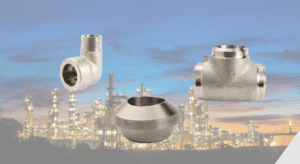
You’ll find forged branch connections everywhere reliability is non-negotiable. Unlike conventional welded or cut-in branch connections, which can introduce localized stress points and potential weak spots, forged branch connections maintain uniform wall thickness and provide a smooth, contoured transition that enhances both mechanical strength and fluid flow characteristics.
These components are precision-machined from forgings, and bars – materials that have undergone compressive forging to refine the metal’s grain structure. This process produces a dense, homogeneous material with superior mechanical properties, including higher tensile strength, impact resistance, and fatigue performance. It’s a fitting built to handle the heat and pressure, so you don’t have to worry about it.
In addition to strength, forged branch connections offer dimensional accuracy and consistency that simplify installation and ensure compatibility with various pipe schedules and end preparations. Their robust design minimizes the need for additional reinforcement pads or complex weld configurations, reducing both fabrication time and inspection requirements.
By combining precision forging with optimized geometry, these fittings deliver exceptional durability and reliability – making them a preferred choice wherever safety, long-term performance, and compliance with demanding codes such as ASME and MSS-SP standards are required.
Why Reinforcement Matters
Every branch outlet is a potential weak point in a pressure system. Poor reinforcement or inconsistent weld geometry typically results in localized stress concentration, corrosion initiation at pits or microfractures, or fatigue failure. Forged branch connections inherently solve this by maintaining:
- Controlled wall thickness across the outlet region
- Smooth stress transition from run to branch
- Superior fatigue and pressure-cycle endurance
Each forged branch acts as a reinforcing stress-distributor and outlet in one, providing enhanced mechanical strength/resilience with low fabrication effort.
Why Our Customers Trust Penn Machine
When you’re managing mission-critical piping systems, you aren’t just buying steel—you’re buying risk mitigation. That is exactly why both engineers and procurement managers specify Penn Machine. We design our components to eliminate your compliance headaches before they ever start.
Our forged fittings and branch connections provide:
- Full material traceability
- Uniform wall transitions and stress distribution
- Compatibility with ASME, MSS, and API piping codes
Collectively, these are defined with the MSS-SP-97 Standard
Consolidation and Inventory Efficiency
You don’t have to stock multiple T-joints. Because one Penn Machine forged branch connection can often cover multiple run sizes, you can slash your SKU count. For procurement teams, this means faster RFQs, less capital tied up in the warehouse, and the confidence that the right part is on the shelf when an emergency call comes in.
PennUSA specializes in forged branch fittings that offer:
- A smaller, standardized inventory can cover a wider range of configurations
- Material traceability becomes centralized through unified forging batches
- RFQ processing becomes faster, since engineers can select from a pre-qualified, dimensionally consistent library
This means less time spent managing part numbers and more time ensuring system integrity. For procurement teams, fewer SKUs translate to reduced carrying costs and faster sourcing cycles.
Design Advantages of Forged Branch Connections
Strength Through Forging
Forging compresses and reforms metals’ atomic/crystalline structure, producing directional strength and stress distribution, and eliminates internal porosity common in cast or welded parts. The result is improved fatigue resistance, impact toughness, and pressure performance.
Streamlined Geometry
The forged outlet’s contoured transition minimizes stress concentrations at the weld toe, a critical benefit under cyclic thermal or pressure loads.
Superior Weldability
Each fitting is machined for consistent weld bevels and radii, reducing the risk of misalignment and ensuring repeatable, code-compliant joints that pass NDT evaluation more readily.
Pressure and Temperature Range
Available in Carbon, alloy, stainless, and Nickel-based super-alloys, Penn Machine’s forged fittings and branch connections maintain reliability from cryogenic to high-temperature service, up to Class 6000 and beyond.
Custom Forging Capabilities
When standard designs won’t do, engineered-to-order branch fittings can be forged to match non-standard wall schedules, exotic alloys, or high-pressure ratings.
Applications Across Various Industries
| Industry | Typical Use Cases | Design Priorities |
| Oil and Gas | Flowlines, manifolds, separators | Pressure integrity, corrosion resistance |
| Petrochemical | Reactor vessels, heat exchangers | Reinforcement, temperature cycling |
| Power Generation | Steam piping, condensate systems | Fatigue strength, weld uniformity |
| Shipbuilding | Fuel and hydraulic systems | Compactness, vibration endurance |
| Industrial Process | Compressed gas and hydraulic systems | Inventory simplification, ease of welding |
Engineering Integrity: Manufacturing Standards and Testing
Penn Machine’s forged branch connections are produced under strict metallurgical and dimensional control. Each step, from billet selection to heat treatment, is designed to preserve mechanical properties and compliance.
Typical Standards and Testing:
- ASME B31.1 / B31.3 for pressure piping
- MSS-SP-97 for integrally reinforced fittings
- API 6A / 16A for high-pressure oilfield service
- Non-destructive testing (NDT) – ultrasonic, MPI, liquid penetrate testing, and radiography
- Material Test Reports (MTRs) and Positive Material Identification (PMI) for full traceability
This ensures every forged branch leaving the plant is ready for critical service – not just on paper, but in real-world stress environments.
Reliable Supply Chains
Forging technology has advanced far beyond traditional hot-working. With digital simulation, precision heating, and energy recovery systems, Penn Machine’s production lines minimize waste and improve consistency.
Key sustainability gains:
- Reduced raw material scrap (vs. machined-from-billet components)
- Lower energy input through optimized forging cycles
This approach aligns high-performance engineering with environmental responsibility, positioning forged solutions as the modern choice for efficient manufacturing.
Cost and Lifecycle Benefits
While the initial unit cost of a forged branch connection will typically exceed that of a simple welded outlet, the total lifecycle value tends to be superior in higher stress and more corrosive environments/media. Engineers typically see:
- Fewer fabrication hours (less welding, grinding, and NDT)
- Lower QA/QC complexity
- Reduced rework and field repairs
- Simplified documentation and traceability
When factored into total installed cost (TIC), forged branch fittings consistently outperform their fabricated equivalents-especially in high-pressure or corrosive environments.
Integrating Forged Branch Connections into RFQs
When preparing RFQs for project bids or retrofits, procurement teams benefit from consolidating on forged solutions:
- Unified material specs simplify evaluation
- Standardized dimensions reduce drawing revisions
- Certifiable quality streamlines vendor qualification
Penn Machine offers custom forging programs for OEMs and large EPC projects, ensuring continuity across batches and helping clients achieve inventory reduction without design compromise.
Have a non-standard wall schedule?
Our team is ready to machine a custom solution to fit your specific project. Contact us today to get started.