High-performance computing, hyperscale analytics, and AI workloads are rewriting the thermal design rulebook for modern data centers. Core processors, graphics accelerators, and custom silicon now churn out unprecedented amounts of heat. In this new era, facility leaders must treat cooling not as a background utility, but as a strategic element of overall thermal management, energy efficiency, and business resilience.
By pairing a purpose-built liquid cooling system with disciplined airflow containment, data center operators can keep server inlet temperatures within the American Society of Heating, Refrigerating, and Air-Conditioning Engineers (ASHRAE) recommended band, support higher rack density, and deliver an efficient cooling solution that scales with business demand.
What Is Data Center Liquid Cooling?
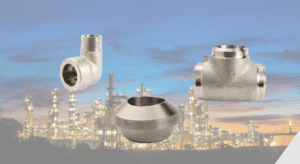
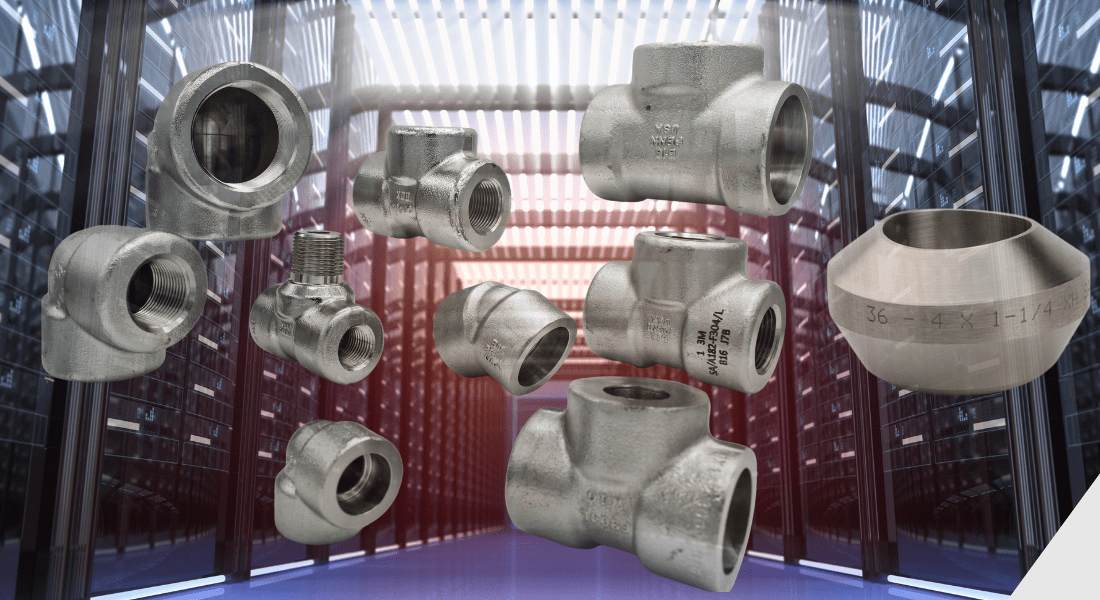
Data center liquid cooling replaces or supplements legacy air cooling systems by circulating a liquid coolant — typically water, glycol, or a specially formulated dielectric fluid — directly to the hottest components inside the rack. Unlike air, liquid boasts roughly 3,000-times higher volumetric heat transfer capacity, a physics reality that unlocks rack densities impossible for purely air-based cooling systems. Popular liquid cooling options include direct-to-chip cooling and immersion cooling. Both trim fan power, shrink thermal gradients, and make it easier to harvest otherwise wasted heat for secondary processes. Our forged fittings in carbon and stainless steel are ideal for preventing fluid contamination and resisting the corrosive properties of treated water loops.
According to the U.S. Department of Energy’s Federal Energy Management Program (FEMP), “Data center energy performance can be tracked in terms of power usage effectiveness (PUE),” the ratio of total facility energy to IT load. A PUE of 1.0 would be perfect, indicating that all energy use goes toward computing.
While standard air-cooling efficiency thresholds plateau, hyperscale closed-loop liquid architectures are continuously pushing facility PUE closer to the absolute theoretical minimum. We engineer our fittings to handle the evolving pressures and flow rates of next-generation thermal designs, ensuring your infrastructure is ready for whatever efficiency benchmarks the industry demands next.
Why Is Data Center Liquid Cooling Becoming so Important?
Processor roadmaps show no sign of slowing. Modern data centers now regularly go beyond the energies that air cooling can effectively handle. After this point, liquid becomes the only viable route to safe operation. Power density targets for AI data centers are accelerating the shift.
Traditional air-cooling systems also struggle with water consumption and sustainability mandates. The uncontrolled recirculation in air-cooled halls increases both electrical draw and evaporative cooling tower makeup, hampering corporate water usage reduction goals. In contrast, a sealed liquid cooling system often operates with warm, closed-loop chilled water, cutting chiller runtime and reducing overall water consumption.
By removing heat at its source, operators gain tighter temperature control, improved thermal management, and a direct path to higher energy efficiency. Custom fittings and our in-stock inventory from Penn Machine help assemble leak-free coolant distribution units (CDUs) and manifolds that comply with regional codes and aggressive project schedules.
Types of Data Center Liquid Cooling Technologies
Liquid cooling technology is not monolithic. Each approach delivers distinct benefits, capital costs, and operational profiles, giving data center operators a menu of liquid cooling options to suit legacy or greenfield facilities.
Direct-to-Chip (Cold Plate) Cooling
This direct liquid cooling method channels liquid through precision-machined plates clamped to hot-running silicon. It’s relatively easy to integrate with existing air-cooling systems, creating a hybrid cooling environment where air handles peripheral devices while liquid manages the highest heat flux zones. Because secondary fluid networks operate close to critical electronics, mechanical joints must be flawless. Integrating precision bar stock fittings and heavy-duty forged fittings and branch connections at connection manifolds provides the structural integrity required to eliminate micro-leaks under constant thermal cycling.
Immersion Cooling
Immersion cooling submerges complete server assemblies in a bath of dielectric fluid. Single-phase systems rely on pumped circulation, whereas two-phase liquid immersion cooling exploits boiling and condensation for extreme heat transfer. Immersion tanks eliminate internal server fans, slash noise, and can reduce the physical footprint of the cooling system by up to one-third versus traditional air cooling. Operators must, however, vet fluid chemistry, disposal pathways, and long-term supply contracts.
Rear-Door Heat Exchangers (RDHX)
An RDHX is a liquid-cooled coil mounted on the back of a rack that captures exhaust before it spills hot air into the aisle. This hybrid cooling path is popular for incremental upgrades because it preserves existing air-cooling infrastructure while alleviating localized hotspots. Successful deployments demand careful structural analysis, attention to condensate drains, and chilled water supply temperatures that align with desired thermal setpoints.
Hybrid Cooling Architectures
Many modern data centers blend liquid and air cooling, creating a hybrid cooling topology that targets only the most demanding racks with liquid while leaving conventional servers on upgraded air-cooling systems. This staged approach balances capital spend against business urgency, offering a pragmatic bridge toward full-scale liquid cooling adoption.
Benefits of Data Center Liquid Cooling
A well-engineered liquid cooling system delivers benefits that resonate from the white space to the balance sheet.
High Rack and Power Density
AI accelerators and high-performance computing nodes routinely draw 50 kW to 100 kW per rack. Liquid cooling maintains safe temperatures without the need to derate servers or spread them across additional racks, preserving valuable floor area and aligning with condensed data center infrastructure solutions.
Energy Efficiency and Thermal Management
By removing heat at its point of origin, liquid cooling reduces fan energy, allows much warmer chilled water setpoints, and trims compressor runtime. These gains translate directly into a lower PUE and a more efficient cooling solution overall. Greater thermal management precision also safeguards components from thermal cycling, reducing failure rates.
Sustainability, Water Usage, and Waste Heat Recovery
Liquid loops often operate at temperatures that enable dry coolers or adiabatic units, slashing water usage compared to evaporative towers. Additionally, the higher temperature of the return liquid makes it easier to capture and reuse waste heat in campus heating or absorption-chiller applications.
Reduced Maintenance and Cleaner Hardware
Less airflow means fewer airborne contaminants, which mitigates dust accumulation and corrosion. While liquid loops introduce tasks such as coolant sampling, filtration, and preventive leak checks, these regimens are straightforward and can be managed with scheduled coolant distribution unit maintenance.
Scalability and Flexibility
Because liquid cooling solutions range from RDHX to full-tank immersion, data center operators can select the right liquid cooling option for each rack, row, or hall, enabling phased migrations that align with budget cycles and business growth.
Five Implementation Strategies
Here are five implementation strategies that, with the right equipment and hardware, can effectively cool even hyperscale data centers:
Strategy 1: Establish a Robust Baseline
Begin with a detailed thermal audit that captures air temperatures, heat transfer bottlenecks, and rack-level power density. Computational fluid dynamics, thermal imaging, and smoke visualization reveal where hot air recirculates and where cold supply air short-circuits. Reconfigurations, such as hot aisle/cold aisle containment, blanking panels, and variable-frequency fan drives, will stabilize airflow and may unlock additional headroom before liquid plumbing even starts.
Strategy 2: Engineer the Liquid Cooling System for Compliance and Growth
Selecting pipework, valves, and manifolds is more than a mechanical decision; it’s a risk-mitigation exercise. Stainless or coated carbon steel offers rugged corrosion resistance, while welded joints or forged steel branch connections eliminate leak points.
Ensure every heat exchanger, rear door heat exchanger, and coolant distribution unit carries the necessary certifications. Manifold distribution headers require highly reliable reduction points and outlets. Utilizing high-integrity branch connections and precision-machined swages ensures laminar flow and removes the stress concentration points common with poor field-welding. This is where sourcing domestic, fully traceable forged components protects the entire infrastructure.
Strategy 3: Integrate Smart Controls and Monitoring
A high-resolution sensor network underpins efficient cooling. Rack-level temperature probes, differential pressure sensors, and flow meters feed data to the building management system, which modulates variable-speed pumps and valves for efficient cooling. Broader dead bands that still respect ASHRAE limits prevent unnecessary compressor staging, lowering energy and water consumption. Real-time alarms flag anomalies so technicians can act before coolant leaks or pump cavitation affect uptime.
Strategy 4: Optimize Water Quality and Chemical Treatment
Even closed-loop liquid cooling systems benefit from vigilant water quality protocols. Regular conductivity monitoring, pH control, and biocide dosing prevent scale, corrosion, and microbial fouling that would degrade heat exchanger performance. Establish quarterly testing and partner with a trusted lab to benchmark results, then dial treatment regimens as needed.
Strategy 5: Plan for Expansion and Hybrid Cooling
Few facilities rip and replace every rack at once. A phased roadmap lets teams pilot direct liquid cooling in the most demanding racks, extend rear door heat exchangers to adjacent rows, and gradually shift from traditional air cooling systems toward a full liquid cooling solution. This hybrid cooling approach reduces financial risk and keeps business services online throughout construction.
Get the Right Components for Your Cooling Needs
The success of a data center liquid cooling project hinges on the quality of every pipe section, elbow, and gasket. Even a single faulty fitting can compromise the entire cooling system, threatening availability and forcing emergency water shutoffs.
Penn Machine’s domestically produced, fully traceable, forged steel pressure fittings and branch connections bring peace of mind to mission-critical environments. Our extensive in-stock inventory, rapid turnaround, and 24/7 customer service ensure that modern data centers never wait for parts.
Ready to enhance your liquid cooling infrastructure with an efficient cooling solution that meets or exceeds code? Contact us today or explore our resources to see how our data center infrastructure solutions support operators nationwide.
FAQs About Data Center Liquid Cooling
Here are some frequently asked questions about data center cooling:
Data centers use air cooling, liquid cooling, or both. Air cooling systems rely on devices to chill room air, then circulate it through servers before transferring heat to chillers, condenser loops, and cooling towers. Liquid cooling systems move heat via water or dielectric liquid in direct contact with hot components, driving higher heat transfer rates and cutting reliance on high-velocity airflow.
Yes, though trade-offs exist. Single-phase or two-phase immersion cooling replaces water with a dielectric fluid for liquid immersion cooling, eliminating on-site water consumption. Dry coolers or refrigerant-based systems can also eject heat without evaporative towers, but they may impose higher electrical loads and capital costs.
Key components include cold plates or immersion tanks, coolant pumps, heat exchangers, rear door heat exchangers, coolant distribution units, leak-detection sensors, and forged steel fittings that maintain pressure integrity across the loop. Each element contributes to dependable thermal management and energy efficiency.
Power usage effectiveness (PUE) is the ratio of total facility energy to IT energy. Traditional air cooling can lock PUE around 2.0, meaning half of all power feeds non-computing loads. By enabling warmer chilled water, minimizing fan energy, and maximizing efficient heat transfer, advanced liquid cooling solutions can move a facility towards 1.6 or lower while supporting future-proof power density requirements.
Although liquid cooling systems employ water or other liquids, they can operate in closed loops. Their ability to use warm liquid enables dry coolers or adiabatic systems that reduce water consumption compared with traditional evaporative towers. Thoughtful design can therefore improve both energy efficiency and water usage metrics.
Absolutely. Hybrid cooling strategies blend direct liquid cooling for the most demanding AI servers with optimized air cooling for lower-density racks. This balanced approach lets data center operators control capital expenditure, maintain flexibility, and deliver efficient cooling across diverse workloads without committing to a single technology from day one.
Learn More
Explore Penn Machine’s complete line of domestically manufactured fittings and branch connections or contact us to receive a quote for your next project.